

Polymarket News Index
What the news says about every outcome of the 200 most traded Polymarket events, next to the price. A language model reads thousands of articles a day against each market's outcomes; the result is a news line, a news-implied probability and an alert when the two move apart, with the articles behind it. In many markets the news and the price move together, sometimes strikingly closely; in others they part ways, and every market carries its own record.
The top ten
The markets where the news alone, read from the day's articles with no market data, has followed the price most closely over their history. Pick one to open it below.
What moved
Ready-made lists from the hourly release: where the news moved most, where it disagrees most with the price, what the press covered, what is about to resolve. Provisional until the day's final release, after 01:20 UTC.
Nine months, 257 markets, 751k articles
We replayed 2026 from January to October before going live. The paper has the method, the sample questions, the full distribution, the top ten and the rankings, what did not work, and the threats to validity.
27%
1% by chanceof markets with 12+ weeks of data where the news alone correlates with the price above 0.5 (14% above 0.7)
59%
41% by chanceof market-days where the articles put the market’s favourite first
67%
50% by chanceof outcome pairs ranked by the news in the market’s order
+0.073
+0.031 nullpartial correlation of the news with the next day’s price change, beyond the market’s own reversion (t = 9.7)
The spread between markets is the most interesting result: the best track at 0.85–0.90, and 30% correlate negatively. It is not explained by the smoothing window, the article volume or the category alone. The questions were written after the period they are tested on, so the live feed, running since 3 October 2026, is the out-of-sample test.
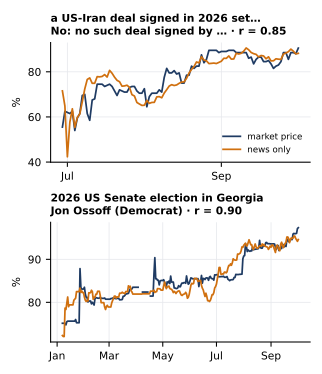
Two of the closest markets. Blue: the price. Orange: the news alone, from the day’s articles with no market data, rescaled to the price’s range. From the paper, Figure 1.
How it works
Four steps. The price enters only at the end, where the news is compared with it; the news line itself never sees a price.
- 01
Pick the markets
Every day, the 200 open events of both Polymarket exchanges with the most traded dollars over 30 days (from the trade tape), sports and automated markets aside. Each becomes one question with mutually exclusive outcomes, priced from its order book.
- 02
Write the query, once
Claude drafts each new market’s question, outcomes and keyword filter in about a minute; automatic checks test the prices, the filter’s volume and a sample of its articles. The queries are not published.
- 03
Read the news
English articles from 2,654 outlets (GDELT), first 260 words, de-duplicated. An open-weights 12B model reads each one three ways against every outcome, each against the same prompt with an empty article.
- 04
Compare, every hour
Per outcome: the news read and its smoothed line, a news-implied probability next to the price, the order of the outcomes, and rule-based alerts with links to the articles behind each move. Final values once a day.
Four things people ask
Every day, the articles that a market’s keyword filter lets through (about ten a day for the median market, from GDELT’s English outlets) are read by an open-weights 12B language model against the market’s outcomes: which outcome the article supports, whether it is this outcome, whether the chance goes up or down. Each read is taken relative to the same prompt with an empty article, so the model’s own prior cancels. The reads are averaged per day and smoothed; no price goes into them.
We do not know yet, and it is the question we find most interesting. The match is not explained by article volume, category or the smoothing window alone. Some markets are priced on information the press does not carry (polls, order flow, insiders); in others the filter lets through articles about the wrong thing. Every market carries its own track record (correlation, the same against unrelated markets, how often the favourites agree), so you can judge each one rather than the average.
Pooled over every market, the news carries a small forward signal on the next day’s price change beyond the market’s own reversion, and it grew through the year. We did not test a trading strategy, and the questions were written after the period they are tested on: the live feed is the out-of-sample test.
The index is provided for information and research purposes only. It is not investment advice, not a recommendation to trade any contract, and not a forecast. Anyone using these data does so at their own risk.
Each market’s question, outcomes and keyword filter are drafted once by Claude, checked automatically (prices, filter volume, a relevance sample) and revised when a market changes; a market that is revised gets a new version and a full new history. A drafted market matched or beat our hand-built ones. The per-market queries are not published; the data computed from them is, every hour.
Open data, every hour
Everything on this page is a static file: the market list, each market's state and daily history, the alerts, daily, weekly and monthly files and top lists. They live on the data API page, free with a key, with an agent prompt, curl and Python examples.
Free with an API key
Register once with a name, a company and an email; the key comes by email and opens every file, from the browser, a script, a spreadsheet or an agent.
Polymarket News Index is news analysis provided for research and entertainment only. It describes what the press is saying next to what the market prices; it is not a forecast, not investment advice and should not be relied upon for trading decisions. Not affiliated with Polymarket. See the terms of service.